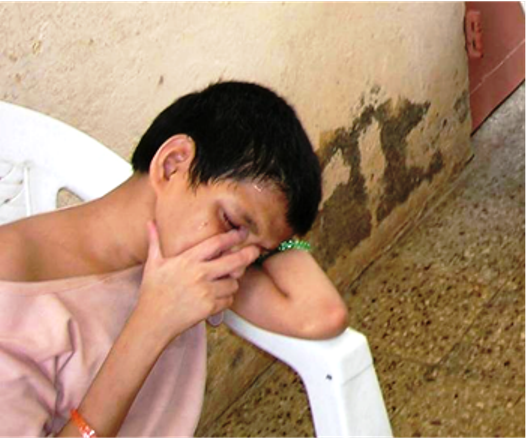
Another of Mother Teresa’s houses of horror: Electroshock therapy as punishment, women chained to beds and more…
(PLEASE TAKE A LOOK AT THE PHOTOS AT THE END OF THE INTERVIEW)
The
following is my hour long interview with a volunteer currently working
in Shanty Dan, a home for mentally challenged women in Kolkata, India.
This particular volunteer has asked that her identity remains private as
she is still working inside this home.
The following is a
shocking and terrifying look at one of the medical institutions
operated by Mother Teresa’s Missionaries of Charity and another primary
example of the rampant negligence that is now far too common with this
organization.
January 24th, 2011
Interview by Hemley Gonzalez
www.stopthemissionariesofcharity.com
Hemley Gonzalez: Please tell us about this home you are volunteering in:
Volunteer:
This particular facility holds between 250-300 female patients at any
given time; it consists of a large building with two stories, general
dormitories packed with beds, a large interior hallway where the
patients spend most of their time, bathrooms and a dining room.
HG: What exactly is the specialty of this medical facility?
V:
Actually from what I understood initially, it’s not meant to be a
medical facility, but rather a home that women with mental health
problems go to, and once they get better they return to their homes.
HG: Would you then say it is a mental institution?
V: Yes, it seems like a psychiatry-unit type of place.
HG:
When you say psychiatry unit, are there any certified psychiatrists
permanently in the building who actually administer treatment? And could
you please elaborate on the type of treatment these women receive while
in this house?
V: There’s a
doctor who comes in once a week, on Tuesdays, none of the volunteers are
quite sure on his credentials and or qualifications in psychiatry,
psychology or otherwise. In addition to this man’s visit, there is a nun
who resides in the home and is in charge of handing pills to all the
patients, again, not really sure what the pills are exactly as
information is rarely shared with volunteers but the number of pills
handed out is staggering.
HG: Do you think these are psychotropic medicines that are being given to ALL patients?
V: Definitely a mood altering drug and it is handed to both the upstairs and downstairs patients.
HG: And this broad regiment of pills for all the patients is prescribed by one doctor who comes in only once a week?
V:
Yes, there is no proper diagnosis, but rather some ideas which they
come up with while quickly observing the patients. I believe sedation is
more of the goal rather than specific diagnosis.
HG: How many nuns are on staff and how many paid workers who operate this house?
V: Six paid workers and three nuns
HG: Do they provide meals for these patients?
V: Yes, breakfast, lunch dinner and tea and biscuits as snacks.
HG: How many volunteers come to the house and for what length of time each day?
V: Usually ½ a dozen or less, we come in the morning about 8:00AM and leave by 12-1PM
HG: What are volunteers asked to do?
V:
We do practical chores, check and treat for lice, combing and cutting
hair, nails, etc. Although I thought the focus was and should be
rehabilitation programs with these patients.
HG:
When you talk about lice, are these in patients who are just arriving or
some of the ones who have been in the home for a while?
V:
Well, it looks like the problem is always present, even when new
patients come in without it; we seem to have the lice in our long term
patients as well.
HG: Doesn’t it seem odd that a medical facility has an ongoing lice problem?
V:
Well, the way I had been presented with information about this house, I
thought I was coming to a home and not a medical place, but now after
been here for over a month, I see how it completely is a medical
facility, as all these women are constantly being given drugs and on
Tuesdays there is additional treatment performed by the visiting doctor.
HG: What kind of treatment?
V:
It’s actually been one of the most disturbing things I’ve ever seen; it
is electroshock treatment, and something that now I’ve noticed is far
too common. Many of the women who first come in are given it for six
weeks, especially those who are physically unruly, and to the point
where they only stop the treatment in some of them until they completely
stop talking.
HG: So are you saying that patients
who come in and aren’t properly diagnosed or as it seems to be the
case, not diagnosed at all are receiving electroshock therapy so they
can be subdued?
V: Yes. A lot of
the women are suffering from incidents that have happened in the past,
not necessarily being physically violent, suffering from internal
trauma, perhaps some anger issues, asking for attention, and perhaps a
range of other psychological ailments but the problem is that no one
assesses the problem, how to treat the problem and actually treat the
problem properly. They are just given electroshock therapy!
HG:
So they are resorting to deliberately applying electroshock to these
women without actually diagnosing their conditions as a way to try and
calm them down?
V: Yes.
HG: How many instances of these electroshock therapies have you personally witnessed?
V:
Usually on Tuesdays is when they do these treatments because that’s the
only day the doctor comes, and the first time I witnessed 6 women going
into the room.
HG: How different was the behavior prior to and after receiving these treatments?
V:
There is one patient for example who is very outspoken, likes to sing
and engage in conversation with volunteers and other patients, when she
came out of the room she was almost in a comma stage, foam coming out
her mouth, unresponsive and was wheeled out in a stretcher. A few hours
later she became somewhat conscious and was complaining of a massive
headache and dizziness as well as being extremely confused. Clearly a
horrible feeling for anyone who is submitted to this sort of procedure.
HG: So this goes on Tuesdays. Have you witnessed it taking place on more than one week?
V:
Yes I’ve seen it a number of weeks since I’ve been here and many women
going through the same, but more recently since myself and other
volunteers have been very worried and spoken about it they started to do
it in hiding, so it’s hard to tell which women are being submitted to
it and how many.
HG: Did you actually witness some of the electroshock procedures and how many?
V:
Yes, I saw a line of women waiting for the application and after seeing
the first one being applied, it horrified me. The women waiting in
line were not told anything that was about to happen and became
apprehensive as some of the other women who had been submitted to the
electroshock were being wheeled out of the room in a stretcher while
foaming at the mouth.
HG: After you spoke about this barbaric practice, what happened?
V:
Almost immediately they banned volunteers from coming near the room
where the electroshocks are performed. The glass window that looks into
the room was covered with a curtain and on Tuesdays, the day they are
performed, volunteers were being asked to perform other tasks away from
the area where the treatments take place. What’s even worse now, the
nuns are considering to close the doors to volunteers, so the horrors
will continue without witnesses who can defend these patients.
HG:
Do you believe these nuns are actually performing electroshock therapy
themselves without the presence of the doctor who comes in once a
week?
V: I wouldn’t put it pass
them. And in any case, they line up the women they want to punish and
make the doctor apply the electroshock on Tuesdays. Some of them for up
to six weeks which basically renders them useless for a long time
after.
HG: How do they hide the treatments now?
V:
One of the French volunteers who spoke up a week ago was kicked out by
one of the nuns and was asked to never come back. Then I spoke up and
went as far as writing a report which the nuns in charge refused to
read, basically telling me I didn’t know anything about what was going
on, and that I didn’t have any medical experience to question them.
HG:
Now that you have been forbidden to participate or witness the
electroshock sessions of which you spoke against so strongly, what
other tasks you asked to do with your time there?
V:
We try to do some fun activities with the women, playing games,
speaking to them kindly (unlike the forcefully and aggressive manner in
which the nuns often speak to them).
HG: Do any of these nuns themselves have any medical experience, expertise and or certification in the psychiatric field?
V: No. The nun in charge used to be a dentist, and that is the extend of the medical knowledge from any of them in this house.
HG: So one volunteer has been kicked out and your concerns and report ignored?
V:
The report I gave to the nun, was intended for the nun, and the
interaction between her and the doctor who could care less about any of
these women. He doesn’t diagnose them and seems to be more interested in
just applying the electroshock when he does his weekly visit. If the
women are kept sedated so they don’t create additional work for the nuns
or the paid workers, then the doctor does his job “well”. There is a
nun who is basically in charge of choosing which women are to receive
the electroshock, and incidentally also has the power to stop it, so I
figure I would research some information about electroshock therapy and
show her the devastating effect this type of treatment could have on
people who are not candidates for it in hopes of stopping this madness.
A
lot of the information available in the web and medical sites all point
to the same problematic side effects, such as memory loss, and in
applying the findings to the patients directly I started to see how a
lot of the cognitive functions were affecting their brains; particularly
in women where there was some sort of normalcy days prior to them being
placed under this barbaric therapy and after having essentially a
mental meltdown.
What really unsettled me was the fact
that a lot of these women came into Shanty Dan to get better and leave,
but this isn’t happening because after electroshocks some of them have
actually made them worse.
HG: What did they do with your report when you suggested all these possible treatments?
V: The head nun, Benedicta basically laughed in my face and flat out said: "I don’t have time to read any of this documents"
HG:
If they are too busy to read reports pertaining the work they are
there to do, what exactly do they occupy their time with instead?
V: Looking after the women I suppose and not very efficiently obviously.
HG:
Why aren’t the nuns at Shanty Dan hiring full time psychiatrists? For
an institution holding nearly 300 patients with a wide range of mental
illness, you would have to have several professionals on staff at all
times. What’s happening here?
V:
When I asked one of the nuns why weren’t any doctors she said the most
ridiculous thing: “there are no counselors in India” “You find them and
bring them here” “you wouldn’t be able to find any around”
HG:
Pardon the expression but that seems to be a crazy thing to say,
wouldn’t doctors love the opportunity to accept a high paying job to
look after 300 patients?
V: Agreed.
HG:
So there is one nun who has some dentistry background, one doctor who
comes in once a week who is supposedly a psychiatrist and prescribes a
broad regiment of pills to about three hundred patients and about six
medically untrained workers who look after the patients. What is your
take of the actual state of this institution?
V: Is
a big joke, they don’t care about any of the women there; they just
have some workers to look after them and don’t seem to take seriously
their conditions, certainly not a home for mentally challenged women
where the goal would be to improve their lives. It’s basically a
building filled with women with lots of mental issues who are vulnerable
and in real need of help.
HG: Where you told or
explained prior to volunteering that this was a place where women would
be helped and or empowered to get better from certain mental illnesses?
V:
Actually we weren’t actually told anything of value at the
orientation/registration which was just two minutes long and they
basically said the place was a home for mentally challenged women. And
of course I assumed this was a place where women got treated properly so
they could get on with their lives, I really didn’t think I would
encounter what I have witnessed in my time here.
HG:
When you speak of aggressive behavior, is this something that happens
frequently at the hands of the nuns and workers who operate the house?
V:
Nuns and workers often treat the women angrily and harshly, they show
signs of disgust and exhaustion in working there and understandingly so
as some of the patients can be a handful, but for a place with three
hundred patients and so little workers, it is expected that problems
will arise. The patients are often beaten by workers who without any
proper medical training often resort to violence in an effort to
institute order.
HG: What kind of financial compensation do some of these workers receive for their work in this home?
V:
I know they are not getting a lot, especially since a many of them live
in slums. In many cases 30-50 rupees a day from what I've heard.
HG:
So these are women from the slums who are themselves in great financial
need and even less likely to obtain medical training to deal with
almost three hundred mentally ill patients?
V:
The workers have their own issues, and they even have come to accept
the idea that the shock therapy is actually a good thing because they
hear it from the doctor and the nuns, in particular nun Benedicta and
another who we’ve branded the evil nun, especially after personally
seeing her torturing some of the older patients.
HG: One of the nuns tortures the women how?
V:
Sadistic stuff, emotional abuse for instance, demeaning them, I seen
her doing that with some of the older patients, for example, one of the
volunteers who comes in and does some of the dressing and cures for
patients who need it, an old lady who has a wound in her back and the
volunteer needed help moving the patient around to get to the sore and
the nun literally yanked her forcefully in front of the other patients,
pulled up her dress and in degrading manner laid her down while asking
the patient to stop being shy and exposing a private and serious wound
to the rest of the floor, zero dignity, while telling her to stop crying
in front of the volunteers and remind her that once the volunteers
leave, she will still be here to deal with her. How sadistic and
frightening is this?
HG: Basically this home becomes a house of horror for a lot of these patients once the volunteers leave?
V: Yes, especially with this one nun who we now call the evil nun, she is middle aged, heavy.
HG: Are most of the nuns obese? I seem to find a large number of sedentary women who work for this organization. Why is that?
V:
She’s actually quite big, a round face Bengali women, and she’s almost
as big as the other two nuns in the house, Benedicta and Maria. They
often just sit around and let the volunteers and workers do most of the
work, of course, their diets are well proportioned with proteins and
items which the patients don’t often get themselves.
Speaking
of this “evil” nun, it’s actually evident that she has some mental
issues of her own, the way she behaves with other patients, very
sadistically, and even the workers agree there is something wrong with
her, as they too allude to the fact that she is especially abusive with
the patients.
HG: So even workers actually admit that there is something wrong with this particular nun who is also running this house?
V:
Yes, all the workers feel very negatively about her and even volunteers
no longer listen to her. In one instance she began to stab the feet of
the old lady with the infected wound.
HG: Stabbing the patient’s feet?
V: Yes with a pair of scissors.
HG: For what reason?
V: It was very strange; it seemed like a personal thrill for her.
HG: And this is being done by a nun who is clearly disturbed?
V: Yes, clearly no sane person does some of the things this woman does.
HG: What would you say is required for this house to operate as the mental facility you thought you were coming to work in?
V:
For starters, a must is a range of doctors, psychiatrists, psychologist
and therapists and not these robotic tools such as the electroshock
machine and this massive distribution of psychotropic medicines to all
patients without diagnosis. There are no personal assessments of the
ailments and or diagnosis for a cure and a long term plan to get these
women to a somewhat normal life and in many cases to a full integration
back to society.
HG: Is the broad application of
medicines to all patients without understanding the specific issues of
what each of them were brought to this house for in the first place
creating more problems?
V:
Exactly. And really to get any of these women to a path of improvement,
there needs to be some consistent and professional counseling, they come
in and many of them could truly be healed with the proper professional
and consistent help.
HG: Would you say any of the
nuns currently on staff are in any shape to adjust to any of the changes
you would like to see for this particular house?
V:
No. As it stands right now they refuse to listen to suggestions,
apparently they’ve rejected ideas and or programs suggested by many
volunteers.
HG: As other houses operated by the
Missionaries of Charity, does Shanty Dan also have hours of prayers
where the nuns are absent from the facilities and neglect the patients?
V:
Yes, and they leave the women workers from the slums in charge the
same group who are medically untrained and get paid very little money
for all the work they do. What’s even more alarming is the fact that the
“evil” nun as we have resorted to calling her has begun punishing
unruly patients by administering electroshock therapy, regardless of
their condition, she has been doing this as a way to subdue them
physically which is disturbing and aggravating to say the least.
HG: Electroshock therapy is actually being applied as punishment?
V: Yes, unfortunately.
HG:
Let’s talk about a bit more about the facility. Are there any outdoor
areas or spaces where they could spend some time in the sun and receive
natural light and other necessary sensory experiences?
V:
There is actually a courtyard with some nice outdoor areas but
unfortunately the nuns have closed off the area to the patients. Their
main complaint is that some of the women were defecating in the grass
and that became too much work for the paid janitors and nuns to handle,
so now all the patients are confined to an inner corridor with some
windows that look out to the exterior but basically all their time is
spent indoors. They really get no natural light anymore and are
essentially confined to these interior corridors, bathrooms and dining
room.
HG: I think it is fair to say that the
entire facility is wrongly and inefficiently staffed, given the fact
that there are no permanent doctors, nuns with basically no medical
training and workers who are at best janitors, wouldn’t you agree?
V:
It would most certainly help to bring in professionals to asses all the
cases of the women currently being kept in the house. While volunteers
come in and try to help, their duties are usually limited to washing
clothes, dishes and some grooming of the patients.
HG: Are there any washers and dryers in the house?
V: No. They’ve refused to accept them.
HG Do you think this house will change and or improve?
V:
Not really. After several weeks of suggesting changes, researching,
handing over helpful documents and speaking to the nuns and workers,
I’ve come to realize they are not interested in altering their culture
of abuse and neglect.
HG: One would also have to
assume that the workers are trying to protect their income, however
little it is and in essence are conspirators to the medical negligence
perpetrated by these nuns on a daily basis.
V:
Yes, they do pretty much whatever the nuns say including systematic
beating of the patients at the request of the nuns themselves.
HG:
It is my understanding that nuns within this organization are shuffled
around the different houses they operate around the world, one of the
reasons being is the mounting complaints and as a way to diffuse the
public’s outrage or concern they continue to change some of them in
charge and dispatch them to different places. How long before they
resort to their malevolent practices in their new positions?
V: Well,
we have already noticed some abusive behavior by nun Benedicta who is
recently new in Shanty Dan; we’ve seen her hitting patients sometimes
and using forceful language, almost as if these patients are wild
animals. I am afraid the behavior is chronic and symptomatic of these
nuns. The same goes for the workers.
HG: Have there been any deaths during your time there?
V:
Yes. Three. One was a new lady that had arrived; she was quite small
and fragile. She seemed fine and had some difficulty walking, but other
than that she was cognitive and responsive. After I returned two days
later I found that she had passed and when I asked for the cause of
death, I was told she had a stroke but there was a lot of ambiguity on
the actual answer, especially when another volunteer felt that the
medicine she had been given was the wrong kind and thus caused her to
have a fatal and allergic reaction.
Another was a 40
something year old patient, her name Maduri, I remember her clearly
because she was the very first patient I saw chained to the bed and now I
see this more and more often. She was very active and always wanted to
leave but one day I came to work and she also died.
And another
patient who was ill was brought here which I thought was very strange,
one who should have certainly been brought to a hospital.
HG: How many patients are chained to their beds?
V:
At the moment from what I can tell probably half a dozen, perhaps more.
And especially those who don’t want to remain in the facility.
HG: So patients who don’t want to stay are not allowed to leave?
V: No
HG: Are there medical histories for each patient?
V:
No. There are just these cards where they sometimes make notes about
the medicines they give to the women, but nothing in detail and
certainly no diagnosis; another thing I noticed is a slew of women who
arrive from jail.
HG: From jail? Please explain:
V:
There seems to be some sort of agreement between the Missionaries of
Charity and some of the women jails where they bring inmates who are
being released but their families don’t want them home, so they end up
here. Many if not all have absolutely no mental disabilities, so I find
this whole arrangement quite strange.
HG: So
perhaps for some sort of rehabilitation program? Except this is a mental
institution which doesn’t even seem to rehabilitate their own mentally
challenged patients in the first place!
V:
Yes, very strange. There are no televisions or rehabilitation programs
or visual or physical activities, they just sit there all day, almost
rotting away. Also, all of the women who arrive from jail join the
distribution of pills and almost immediately become subdued. And most of
the women change their behavior completely and overnight, as if
becoming zombies. There is one in particular which is very troubling to
me, it is a pregnant patient who is constantly being given medicines,
and her mood changes drastically.
HG: These type of pills are being administered to a woman who is pregnant?
V: Yes, even injections that basically knock her unconscious.
HG:
Do we know if the one doctor who visits this home once a week has
actually researched that the medicines he is administering to this
pregnant woman won’t hurt the fetus?
V: No.
HG:
You also mentioned another patient who had a baby recently and the baby
was taken to an orphanage hours away from this facility, something
quite strange considering the fact that the Missionaries of Charity
operate another orphanage literally next door to the same place where
the new mother is. Why would they do this?
V:
When I asked the same question to the nun in charge her answered was:
“God bless you and your compassion” and she laughed and walked off.
HG: Why aren’t other volunteers talking about the same things you have witnessed?
V:
I just don’t think they care enough. They come here for a few days and
don’t want to raise any issues. A lot of them are nice folks but they
just feel helpless at the time or rely on the fact that someone else
like you or me would speak up about it. Or worse, they think these nuns
are actually doing a good job.
HG: I understand
that a first rate health care facility, one that is typically found in
developed countries such as the US, Britain, ect, is not something that
is feasible or realistically possible to construct and execute in places
like Kolkata, but for an organization that receives millions and
millions of dollars in donations each year, is this the best they can
do?
V: No, not at all, at best
they are providing below minimum care. For an organization with European
influence and the massive financial support they receive, this is
shameful to say the least. There needs to be immediate and drastic
changes. The electroshock therapy is running a lot of these women’s
lives, they can never go back out into society and join a cycle of
normalcy, their memories and even simple functions have been sucked out
of them, almost if not all patients are treated like animals in a zoo.
HG: What happens when you leave?
V:
Well, this is why I am talking about it. People like you who continue
to raise awareness about these issues are a major source of hope for
change and this why I couldn’t remain quiet any longer.


.png)
.png)
.png)
.png)
.png)
.png)
.png)
.png)
.png)
.png)
.png)
.png)
.png)
.png)
.png)
.png)
.png)
.png)
.png)
.png)
.png)
.png)
.png)
.png)
.png)
.png)
.png)
.png)
.png)
.png)
.png)
.png)
.png)